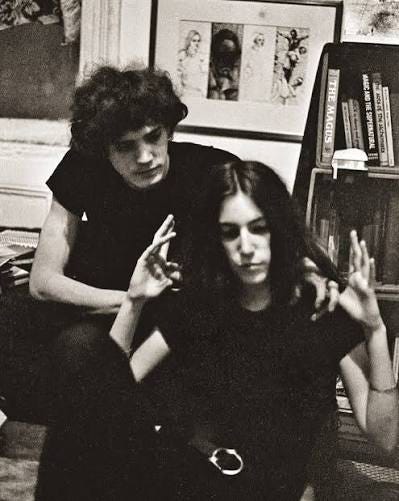
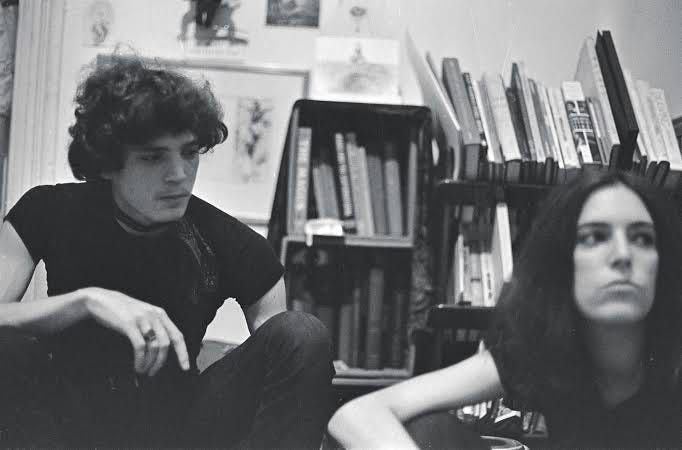
I stepped out of Port Authority bus terminal with my plaid suitcase. My greatest desire at the time was to surrender as an artist. Perhaps I lacked the necessary skills, but I had the willingness to develop them, for I believed in the truth of my calling and was single-minded in my pursuit to find work. It had come to me as if struck with an ecstatic paralysis. There was no Faustian pact connected with my youthful vows, no dark forces, nor expectations from godly elements. In choosing to be an artist I knew I would be on my own, yet still hoped for a compatriot, and providence led me to him.
He was an American boy, raised in a devout Catholic family. He had served as an altar boy, excelled in school, played saxophone in the marching band, and achieved an ROTC scholarship to study graphic art at Pratt. His mother, who favored him, had great hopes that he would enter the priesthood. But his father, preparing him for the military, pictured him rising in the ranks with commercial art training to fall back on. He had pale skin, green eyes, and dark curly hair that was cropped close, military style. He was slightly bowlegged and had a natural sailor’s gait. In accepting the path his father had chosen for him, he was rewarded with an apartment, shiny knee-high leather riding boots, and a stipend. At Pratt he proved himself to be an exceptional draftsman and for a time walked the expected path. No one suspected that another self was growing within.
At the age of twenty Robert Mapplethorpe laid down his robes, his saxophone, his boots and rifle. He had experimented with LSD. He looked in the mirror and saw neither a priest nor future captain in the ROTC. He saw himself. The intermittent shuddering that he had felt throughout his life was now undeniable. That shuddering was Art. It was a calling. Gazing in that mirror, he committed himself in an instant, and just as swiftly, all was stripped away. His scholarship, his apartment, his allowance, his shining boots, and, most profoundly, his father’s approval. He tapped his thigh and stepped into a new world.
He stayed for a while in a small empty room of a friend’s apartment. He slept on a simple white iron bed, surrounded by his portfolios. He slept as Eros with his bow balanced by his side, naked, and no flags covered him. That was the boy that I met in the summer of love. I found my way to him, and he opened his eyes and smiled.
We rescued one another. He had been shunned and disowned. I had the emotional and physical scars of a difficult childbirth. We were one another’s buoy, believing in the vows we had made to ourselves. I gave him a silver ring with an anchor; he gave me one in gold with a small stone the color of his eyes. Having little money, we seldom went out at night. We’d play Tim Buckley records and look at our books on Picasso and Surrealism. On rainy evenings languidly lying together, I’d tell him stories or sing him little songs and he would slowly sit up to have a cigarette, with the sheet to his waist. I would glimpse the changeling aspects of my artist: a fragile sailor, a fleeting coquette, or a young geisha with the smallest touch of rouge on the lips. Perhaps he sensed a duality in me, the tomboy who spurned girlish things, yet had secretly yearned for a Communion dress and veil.
From. ART/Rat Bread of Angels.